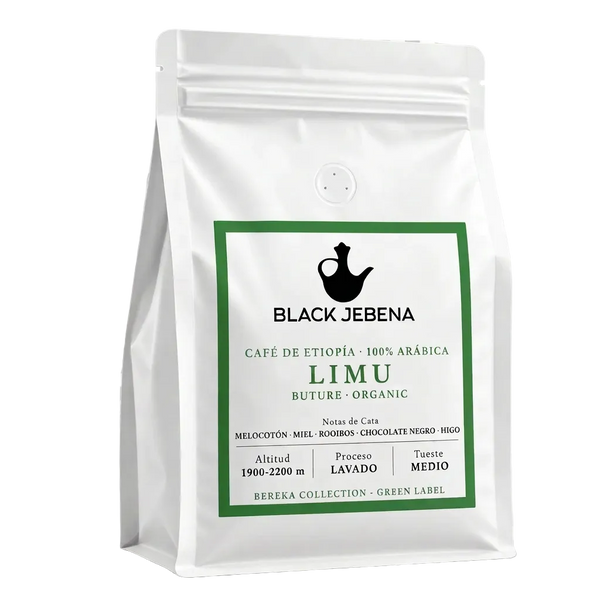
Limu is one of the most confusing names in Ethiopian coffee. It is two districts of the Jimma zone, in the south-west of the country, and at the same time a trade label under which washed coffee from that whole zone has been sold for decades. In the cup it is usually balanced and smooth, with red fruit, a winey, spicy touch and gentle acidity.
It is a coffee you understand better once you know where the name comes from.
Zone: Jimma Zone · Oromia
Altitude: 1,700 – 2,200 m
Farming: Shaded gardens and semi-forest
Processes: Mainly washed
Harvest: October – December
Typical profile: Red fruit, winey, spicy
Limu, Jimma and “Djimmah”: three different things
Limu as a territory. Two districts (woredas) of the Jimma zone, in the state of Oromia: Limmu Kosa and Limmu Sakka. Limmu Kosa ranges from 1,200 to 3,020 metres and almost 40% of its area is forest, including two protected forests.
Limu as a trade name. Traditionally, washed coffee from the whole Jimma area was exported as “Limu”, and natural coffee as “Djimmah”, the old spelling of Jimma. Hence the idea that “Limu is washed Jimma”, which is a simplification.
Limu as a broad label. Today coffees from other Jimma districts, such as Gomma, are sold as “Limu”, and some importers extend the commercial region as far as Illubabor. So not all coffee called Limu comes from the two Limu districts.
Landscape and farming
South-west Ethiopia is the wettest and most forested part of the country. In the Jimma zone, coffee grows in gardens and semi-forest, in the shade of trees such as acacias, alongside maize and bananas, on small plots of around two hectares on average. There are also some larger private estates.
Jimma is also the cradle of the country’s coffee research: it is home to the Jimma Agricultural Research Center (JARC), which since the 1970s has selected local coffee plants for their quality and disease resistance.
How it tastes by process
Washed. The classic Limu. It has been described as “a smooth red wine”: red fruit (raspberry), sometimes pineapple, subtle floral notes, spices and a winey touch, with medium acidity and a balanced body. The cherry ferments for 36 to 76 hours and dries on raised beds for 10 to 12 days.
Natural. Historically the norm in the area, sold as “Djimmah”. It gives coffees with ripe fruit, cocoa and more body.
The best-known areas
- Limmu Kosa: a high-altitude district with a lot of protected forest.
- Limmu Sakka (Limu Seka): a high farming area, at around 1,900 metres.
- Gomma: a neighbouring Jimma district whose washed coffees are also sold as Limu, such as those of the Kolla Bulcha cooperative.
- Agaro: home to the Kata Muduga cooperative union, which brings together several cooperatives in the area.
How it differs from other regions
Compared with Yirgacheffe and Sidama. Limu is less floral and citrusy, with softer acidity and more winey, spicy notes. It is a rounder, easier coffee.
Compared with Jimma. Commercially, Limu was the washed coffee and Jimma (or Djimmah) the natural, although today there are specialty naturals and washed coffees across the whole area.
Varieties
Being next to JARC, the area has many of its selections, such as 74110, 74112, 74158 and 74165, as well as local varieties. Our Limu Buture, for example, declares 74110 and 74112. “Limu” and “Djimma” are not varieties, even though they sometimes appear as such in some lists.
How to brew it
Its balance makes it very versatile: it works in filter, AeroPress, moka pot, espresso, French press and jebena. It is a good everyday coffee and takes milk without losing its character.
Frequently asked questions
Are Limu and Jimma the same?
Not exactly. Limu is two districts within the Jimma zone. Commercially, “Limu” was used for washed coffee from the whole zone and “Djimmah” for natural.
What does “Djimmah” mean on a coffee sack?
It is the old spelling of Jimma. Traditionally it indicated natural coffee from that zone.
What does Limu coffee taste like?
It is usually balanced and smooth, with red fruit, winey and spicy notes and gentle acidity.
Is Limu washed or natural?
Traditionally, the name Limu was reserved for washed coffees. Today there can be both, but most specialty Limus are washed.
Is Limu good for espresso?
Yes. Its balance and soft acidity make round espressos that pair well with milk.
Does all coffee called Limu come from Limu?
No. Washed coffees from other Jimma districts, such as Gomma, are often sold under the Limu name.