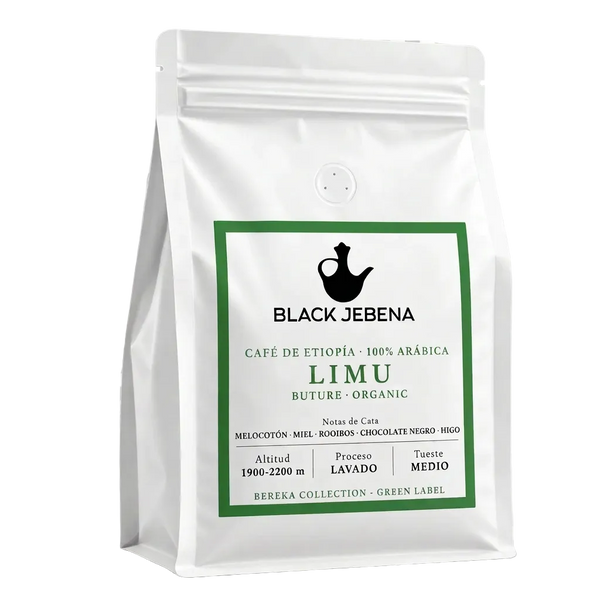
Jimma is one of Ethiopia’s great coffee zones, in the wet, forested south-west of the country. It was once a kingdom and today it is the cradle of Ethiopian coffee research: many of the varieties grown across the country were selected here.
For decades its natural coffee was sold as “Djimmah”, often as commercial coffee. Today it also produces specialty naturals and washed coffees.
Zone: Jimma Zone · Oromia
Altitude: 1,700 – 2,200 m
Farming: Gardens, semi-forest and estates
Processes: Natural and washed
Harvest: October – December
Typical profile: Ripe fruit, plum, black tea
What is Jimma?
The Jimma zone belongs to the state of Oromia and takes its name from the old Kingdom of Jimma, absorbed into the Ethiopian state in the 20th century. It is one of the country’s three big producers, together with Sidama and Gedeo. Within it are Limu, Gera, Gomma and Agaro, names that often appear on coffee bags.
In the trade, natural coffee from the zone was exported as “Djimmah”, the old spelling of Jimma, and washed coffee as “Limu”. For years “Jimma 5” was also the name for low-grade naturals from the west of the country, which gave it a reputation as ordinary coffee.
Landscape and farming
It is a densely forested region. Coffee grows in smallholders’ gardens and semi-forest, averaging around two hectares, in the shade of native trees, and also on private estates such as Gera Estate.
Jimma is home to the Jimma Agricultural Research Center (JARC), which since the 1970s has selected local coffee plants for quality and disease resistance. A study in the south-west found that the cup quality of these varieties rises with altitude and improves with washing.
How it tastes by process
Natural. The zone’s historic process. Ripe fruit, body and, in today’s specialty lots, red berries and grape-like sweetness.
Washed. Clean and floral: orange blossom, jasmine, plum, pear and black tea. In Gera, the coffee soaks in tanks for 36 to 48 hours and dries on raised beds for 10 to 12 days.
The best-known areas
- Gera: estates and cooperatives between 1,800 and 2,200 metres, with very floral washed coffees.
- Agaro: home to the Kata Muduga cooperative union.
- Gomma: cooperatives such as Kolla Bulcha, whose washed coffee is sold as Limu.
- Limmu Kosa and Limmu Sakka: the two Limu districts, with their own guide.
How it differs from its neighbours
Compared with Limu. Limu lies within Jimma; the difference was commercial: Limu the washed, Djimmah the natural.
Compared with Kaffa. Kaffa is known for its forest and biosphere reserve; Jimma for its volume and for JARC.
Varieties
It is the home of the JARC selections: in Gera, 74110, 74112, 74140, 74158 and 74165 are declared, alongside local varieties. “Djimma” is not a variety, even if it sometimes appears as one.
How to brew it
Naturals work very well in the moka pot, espresso and French press, and with milk. Washed coffees shine in filter and Chemex.
Frequently asked questions
What is Djimmah coffee?
The old trade name for natural coffee from the Jimma zone.
Are Jimma and Limu the same?
Limu is two districts within the Jimma zone. Commercially, Limu was the washed coffee and Djimmah the natural.
What is JARC?
The Jimma Agricultural Research Center, which selects coffee varieties in Ethiopia. Varieties with numbers such as 74110 or 74112 come from there.
Why did Jimma have a reputation for commercial coffee?
Because for years its naturals were sold in low grades, such as “Jimma 5”. Today there are high-quality grade 1 lots, both washed and natural.