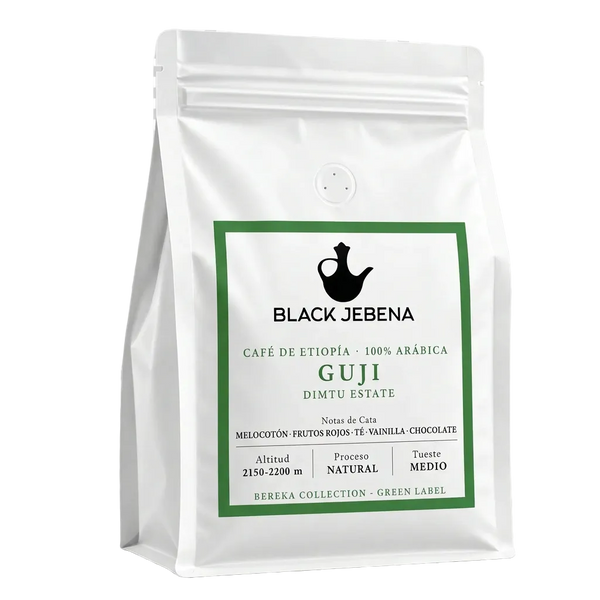
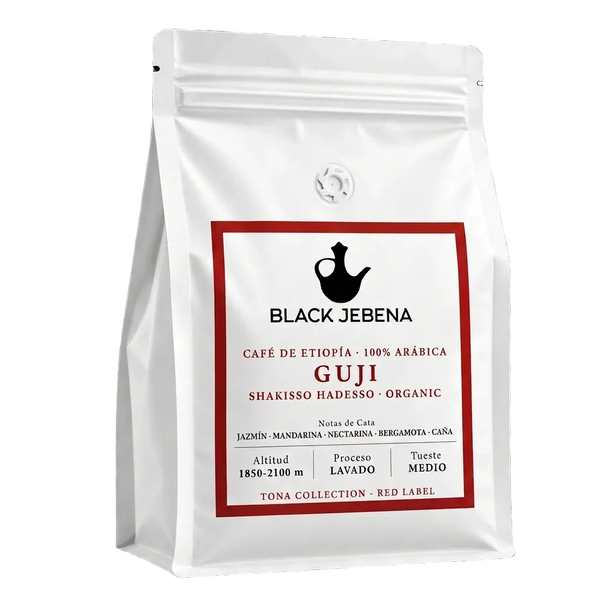
Guji is a heavily forested zone in southern Ethiopia, in the state of Oromia, and one of the origins that has grown the most in specialty coffee in recent years. It is famous above all for its naturals: sweet, with red and blue berries, cocoa and a silky body. But it also produces very refined washed coffees.
For years its coffee was sold as “Sidamo” or even as “Yirgacheffe”. Today it has its own name.
Zone: Guji and West Guji · Oromia
Altitude: 1,800 – 2,300 m
Farming: Semi-forest and gardens
Processes: Natural and washed
Harvest: October – January
Typical profile: Red berries, cocoa, floral
Where is Guji?
The Guji zone belongs to the regional state of Oromia and its capital is Negele. It was created in 2002 by separating the highland districts from the Borena zone. To the north, the Ganale river separates it from Bale; to the west it borders Sidama and Gedeo, the Yirgacheffe zone. The West Guji zone, with its capital in Bule Hora, was created later.
Commercially, Guji coffee used to be sold as part of “Sidamo”. Today it has its own classification, and a small part of West Guji is still sold as Yirgacheffe.
Landscape and farming
Guji is a remote, very green strip with a lot of forest. Coffee grows in semi-forest and family gardens, under the shade of tall trees and alongside other crops. Growers have around one and a half hectares on average and bring their cherry to washing stations that gather hundreds of families.
Guji has less processing capacity than Sidama or Gedeo and is traditionally better known for its naturals.
How it tastes by process
Natural. Its great speciality: red and blue berries (blueberry, raspberry), rose, milk chocolate, pomegranate or cocoa, with a silky body and juicy acidity. The cherry is dried on raised beds for 15 to 18 days, in thin layers that are gradually thickened, protected from the midday sun and the dew.
Washed. Lighter and more floral: melon, mandarin, lemon, honeysuckle or chamomile. At stations such as Hambela, the coffee ferments under water for 48 to 72 hours and dries on raised beds for 9 to 12 days.
The best-known areas
- Hambela Wamena: between 1,950 and 2,250 metres. Stations such as Kercha, Buku and Dimtu; naturals with cocoa, pomegranate and red berries.
- Uraga: up to 2,300 metres, one of the highest areas of Guji.
- Odo Shakiso: more than 5,000 hectares of coffee around Shakiso and Megado. Naturals with rose, blueberry and milk chocolate. Our Guji Dimtu, Shakisso Hadeso and Megadu come from here.
- Adola and Kercha: other coffee districts of Guji and West Guji.
How it differs from Yirgacheffe and Sidama
Compared with Yirgacheffe. Guji usually has more body, softer acidity and more pronounced fruit, and it opens up as it cools. Yirgacheffe is finer and more citrusy, with a tea-like finish.
Compared with Sidama. High-altitude washed coffees are very similar. Guji is better known for its naturals.
Varieties
As in the rest of the country, lots are usually labelled “heirloom”. Behind them are local varieties such as Kudhum (the same one called Kurume in Yirgacheffe) and Wolisho, and JARC selections. Our Guji Megadu, for example, declares 74110 and 74112.
A curiosity: in some parts of Guji, growers call local disease-resistant coffee plants “Bourbon” or “Typica”. They are not the varieties of the same name grown in the Americas; they are local names.
How to brew it
A natural Guji works with almost any method: filter (V60, Kalita), French press, moka pot, espresso, cold brew and jebena. It holds up very well with milk. Washed coffees shine more in filter and AeroPress.
Frequently asked questions
Is Guji the same as Sidamo?
No. Guji is a zone of the state of Oromia. For years its coffee was sold under the trade name Sidamo, but today it has its own classification.
Why does natural Guji taste of red berries?
Because the cherry is dried whole, with its pulp, for two to three weeks. The natural process gives sweeter, fruitier cups than washing.
What is the difference between Guji and Yirgacheffe?
Guji usually has more body and fruit and softer acidity; Yirgacheffe is lighter, more floral and citrusy. They are neighbouring zones and the commercial border has been blurred.
What do Hambela or Shakiso mean on a coffee bag?
They are districts of Guji. They tell you which part of the zone the coffee comes from and, often, the washing station.
Is Guji good for espresso?
Yes. Guji naturals make sweet, fruity espressos and pair very well with milk.
Is all Guji coffee natural?
No. It is best known for its naturals, but there are excellent washed coffees, especially from stations such as Hambela.